25/04/2011

Reminisce Part 2


The overall theme of these columns has been the interplay between place, song and listener in acting as a trigger for memories or impressions. The ability of music to do this is well known, a Proustian effect by which hearing even a snatch of a song can bring recognition of the past in a present moment. It can easily be tested. Search out a song you haven’t heard for many years, perhaps since childhood: close your eyes and listen to it and see what it recalls. I can’t hear the opening bars of Wings’ Listen to What The Man Says without thinking of going to Athens for the first time: it must have been playing on a radio en route somewhere. For those with a certain way of thinking, it can also be quite a useful tool in fixing dates in your mind. Which summer did we go on a family holiday near St Michaels Mount in Cornwall? Wet Wet Wet were singing Love Is All Around for weeks on end, so it must have been 1994.

Songs, of course, aren’t usually written with this mind – they are, more likely, intended for the moment. The track here, however, Reminisce Pt 2 by Dexys Midnight Runners, takes a step back by being a song not primarily about a place but about memories –in this case, of a teenage love affair – recalled by songs of the time. This came from their 1985 album, Don’t Stand Me Down, produced in their phase of looking like Ivy League students or accountants that had succeeded the raggedy gypsy image of the Come On Eileen period. In it, Kevin Rowland remembers, largely in spoken form, a teenage romance , with Jimmy Ruffin’s I’ll Say Forever My Love providing the musical backdrop: this being the song that he and his girlfriend, as they walked home from evenings in Oxford Street and Edgware Road in London, had adopted as ‘their song’. The effect could have been overly - sentimental and twee but somehow comes over as genuine, rather sweet and evocative of a particular place and time - and also a reminder  that the musical landscape of that time wasn’t all flower power or street fighting man. It was also the Kinks and a Soho transvestite, soul and Peter Paul and Mary re-appearing from the early sixties to have their biggest UK hit with a John Denver song.

There is, however, something troubling about this reminiscence – the date the song recalls and the tunes it is remembered by don’t match up. The words place the romance in the summer of 1969. However, the two songs in the running for the couple’s special tune, Lola by the Kinks and I’ll Say Forever My Love by Jimmy Ruffin, came from the summer of 1970, a summer musically over-shadowed by Mungo Jerry’s very non-PC In the Summertime (‘have a drink, have a drive...do a ton or a ton and twenty five’). Likewise, the two songs played on the radio and by which Kevin Rowland remembers that summer - Wedding Bell Blues and Leaving On a Jet Plane – weren’t summer songs at all by the time they reached the UK. Wedding Bell Blues was an early Laura Nyro song, performed by her at the Monterey Festival in 1967, but the USA and UK hit was by the Fifth Dimension, reaching the UK charts in January 1970. Similarly, Peter, Paul and Mary’s version of Leaving On A Jet Plane was on the radio in the winter of 1969 and in the charts in early 1970.

In a real sense, this doesn’t matter and could be poetic licence. This is a song, not a historical record, and there may be good reasons for the switch in year and telescoping songs over a period of time into one summer. There could be also something of the same syndrome you sometimes see when people are asked to name the first record they ever bought, with a temptation for achieving credibility to triumph over reality. Hence, the answer is more likely to be “I saved up for ages to buy an import of BB King playing Blind Lemon Jefferson” rather than the more prosaic “I went with my mum to Woolies and got Do You Wanna Touch Me (Oh Yeah) by Gary Glitter”. Perhaps, in the same way, a lost love is more appropriately remembered by I’ll Say Forever My Love rather than, say, by Middle of the Road and Chirpy Chirpy Cheep Cheep.

Perhaps, too, it merely shows that memory is fallible though, in truth, both Leaving On A Jet Plane and Wedding Bell Blues do sound like summer songs. It is human for the mind to recast the past. It didn’t always snow at Christmas ; the first gig you went to wasn’t really the Sex Pistols at the 100 Club; and it wasn’t always a golden summer on Cromer beach. It only becomes dangerous if you go searching for a rewritten past and expect to find it in the present. This is an odd song. It doesn’t make me think about a place –Oxford Street or Edgware Road - because it is not my reminiscence. It does make me think about the past though, and realise that the distance between now and this song is greater than between the song and the young love it describes. In the interplay of past and present it has itself become a marker along the way.

18/04/2011

For What Is Chatteris


The other side of the coin from being in the sticks and dreaming of the bright lights, big city or making it on Broadway is being in the fast lane of the city and dreaming of the sticks, or more likely the countryside – finding something like the title of David Ackle’s 1969 song, Subway to the Country. That view from the other end of the telescope, of course, has often been a pretty idealised one of rural life, a picture postcard view of a cottage with roses and ivy looking out across a rolling landscape. The desire to get back to nature and a simpler way of life has been a common theme in literature for the past 200 years or so and something similar happened musically in the late sixties, with a string of artists - Bob Dylan, The Band, Stevie Winwood and Traffic, Jethro Tull - suddenly wanting to get it together in the country with a more pastoral hue to their music. The arrival of pop groups in the countryside to discover themselves was not always welcomed. One former resident of the Berkshire village where Traffic recorded their 1967 Mr Fantasy album recalled: “They were a strange looking lot. We'd never seen anything like it. My dad reckoned they were a sweaty, smelly lot. He warned me to keep away from them because of the sex and drugs and that.".

I am not sure who was first. Cliff Richard and The Shadows could possibly lay claim, with their In the Country hit dating to 1966, though the sound here did conjure up the notion of a Sunday drive in a Ford Cortina to have a picnic of hard boiled eggs and jam sandwiches in a field somewhere more than aduki beans and dope in a rural commune. Whoever it was, it set in train several years of British and American artists finding their historical rural roots. Take the Small Faces, the mid-sixties epitome of urban East End mods whose idea of something rural was the bit of waste ground of Itchycoo Park: by 1974 former member Ronnie Lane could bring out the bucolic The Poacher – “Was fresh and bright and early, I went towards the river, but nothing still has altered just the seasons ring a change”. Some songs went for a mystical, magical approach to the countryside, as in Carolanne Pegg’s Witch's Guide to the Underground; some for the whimsical, as with Stackridge and Pinafore Days; some for the comical, as with the Wurzels and I’ve Got a Brand New Combine Harvester.

Most of these painted, in different ways, a rose-coloured picture, though some did point out that life in the countryside could actually be pretty miserable. Recently, Billy Bragg and the Imagined Village band updated the traditional Hard Times of Old England to incorporate the Countryside Alliance and the impact on rural life of the encroachment of Tesco and the closure of post offices.

What is striking, however, is that the view was usually of the deep countryside of cottages and farms. The large village/small market town hardly figured as a vision of escape, yet to a resident of London or Manchester these were just as much ‘the countryside’.

The song here from 2005, then, For What Is Chatteris by Birkenhead indie band Half Man Half Biscuit, redresses that with a double-edged commentary, like much of their work over the past 25 years. A seemingly anonymous small market town in the Fenlands of Cambridgeshire is presented with a blend of witty irony and poignancy, not as a dullsville to escape from to the big city but a gentle idyll which has only lost its charms after a girlfriend upped and left. (Note: there is an extensive internet debate on some of the lyrics and whether the words near the end  say ‘prick’ or ‘crick’ barriers at both ends. Either seem plausible!). I must admit that I have only passed through Chatteris once but it was on a cross-country route to visit my father in a very similar place some 70 miles away, North Walsham in Norfolk. Like Chatteris ,it is a rural market town with some 10,000 inhabitants where the worries are out- of - town supermarkets closing down the local shops, teenagers pulling up the floral display in the park and the odd ‘drive by shouting’.

I often wondered why my father chose to retire there after 40+ years of working in London and the South Coast, as we never went on holiday there or even passed through Norfolk at all to my knowledge. Many years later I found a black and white photograph of a far distant summer, my father as a teenager but looking grown up as though the world was at his feet, standing with his own father on Cromer beach, the seaside town adjoining North Walsham where one stormy evening once I saw Alan Price play at the end of the pier as the waves buffeted the structure. What had pulled my father back there perhaps was the North Norfolk coast shimmering in a remembered golden summer holiday  of a lifetime ago shortly before his father died and his life changed for ever.

Perhaps too it was the predictable nature of life that was attractive. Over the visits there I sometimes thought about the families in the small park down the road from his house. The children went there to play on the swings and roundabout and eat ice - creams; a few years later they were back with their school or college friends, hanging about the park and War Memorial drinking cider and smoking; a few years after that they were back with their own children playing on the swings, whilst around them the town changed little. I was reminded of the Little Bear books by Else Minarik. Only small things happen in these stories: Little Bear puts a box on his head as a space helmet, climbs up a little mound to pretend he has flown to the moon and eventually jumps off again to have his tea. But young children love them because of the safe reassurance of the stories: like North Walsham and Chatteris, you look to enter a small but complete world protected from change. Life there is not being on Broadway, true, but then Broadway -either in reality or the imagination - hasn’t got three good butchers, two fine chandlers, an indoor pool and a first class cake shop.

Link to song

09/04/2011

Nights On Broadway


“Oh, Mary, this London's a wonderful sight, with people all working by day and by night. Sure they don't sow potatoes, nor barley, nor wheat, but there's gangs of them digging for gold in the street. “ So started the lyrics of the Nineteenth Century song The Mountains of Mourne. For those who grew up in the sticks, the seaside or small town, the attraction of the big city - especially a capital city like London or New York – has been a strong one, the ‘streets paved with gold’ story. Going up to London for the first time as a child and seeing more people in one place than you had ever seen before and coming back with a head full of memories of strange things: underground trains, chocolate machines, Beefeaters , weird flattened ducks hanging in the Chinatown windows I had been taken past that looked like a steamroller had passed over them . Or arriving in London to live later on, and seeing the neon lights, cinemas and theatres and amusement arcades of Leicester Square and Piccadilly Circus and thinking – yes, this must be where it is all at.

The same thought occurred on my first trip to New York and seeing Broadway for the first time from the Night Loop Bus, a view only slightly marred by the fact that it was pouring with rain and the bus driver was handing out plastic sheeting. This persistent allure was summed up in the title of the Jimmy Reed song, Bright Lights, Big City, though ‘Big City’ is, of course, a relative concept. On the horse - drawn caravan holiday mentioned in the column on N17, after days slowly meandering in the fields and back roads of County Sligo we came to a large-ish village with a pub or two and some shops, where you could buy things. It felt as though we were rolling into Las Vegas.

The notion of the big city, however, has also had an added moral dimension - the source of temptation and corruption, as with Sodom and Gomorrah – and songs have often seen going off to the metropolis as equalling loss of innocence. There are generally two types of stories here. One is where the narrator/subject either manages to make their escape in time or fails and is chewed up. For the former here, there is, for example, Midnight Train to Georgia - “back to his world, the world he left behind..a simpler place and time’ – or Do You Know the Way to San Jose –‘I’m going back to find some peace of mind’: both about escaping Los Angeles. For the latter there have been several songs about those who headed for the big time and failed to either make it or make it back, including, I suppose, I Guess The Lord Must Be in New York City. A particularly bleak one was by Southern soul singer, Doris Duke, I Just Don’t Care Anymore, from her 1969 album, I’m A Loser, which remains a weary and desperate account of the downward spiral of someone moving to the big city - possibly New York – looking for work and ending up in penniless prostitution. The album has been judged by some as the best deep soul album ever but commercial success eluded both this and Doris Duke’s subsequent work. (There was a similar trajectory with a contemporary of Doris Duke, Chicago/Detroit -based singer Laura Lee who also made some classic soul tracks, such as The Rip-Off, that failed to get much recognition at the time and, like Duke, she moved towards gospel. One of her most haunting songs, Her Picture Matches Mine, even slipped by virtually unnoticed as the ‘B’ side of a single)

The other scenario is where the narrator ,is left behind on a metaphorical station platform, sadly watching as their former friend/lover pulls away and out of sight in the glitz and glamour of big city life. What better to represent this than the archetype of glitz and glamour - Broadway , where the neon lights are bright and there is magic in the air. The song here is Nights on Broadway, written and originally recorded by the Bee Gees on their 1975 Main Course album that acted as the bridge between their earlier ballad-focused work and the disco/funk sound of Saturday Night Fever. Though they had the USA hit, oddly enough the UK hit was by Candi Staton, another Southern soul singer whose early 70’s soul records had gone largely unnoticed in Britain. Instead it was the disco-tinged Young Hearts Run Free that first saw her in the charts in 1976, followed by Nights on Broadway the following year. Whereas the Bee Gees’ version had a feel of the stalking theme of Every Breath You Take to it – ‘Standing in the dark where your eyes couldn’t see, I had to follow you’ – Candi Staton’s take on it , though faster and more disco-fied than the Bee Gees, sounds more a lament from someone left behind and knowing they are up against something far more glamorous.

There is, of course, something of the consciously unreal about Broadway, in some ways the opposite of soul. It is the portal to layer on layer of illusion, whether of the traditional dreams of finding fame and fortune, the plays and shows or the diner/restaurant there that has recreated a mythical recent past where servers sing and dance to 50’s rock and roll tunes in between serving and a waitress fed me birthday cake whilst singing ’Happy Birthday to You’ a la Marilyn Monroe (A ‘Beam me Up Scotty’ moment). People come to see the place of Broadway  but perhaps it is more the idea of it they are looking for.

02/04/2011

Lyla


The last column was about the oddity of places no longer here but that still live on in people’s minds. Those are generally of the local and small-scale: a shop or block of apartments or a cinema or a park. The same thought process, however, can apply on a much grander scale, to whole countries, those which no longer can be found on a map of the world but which still inhabit imagination and songs. Some sound so romantic you can hardly believe they were real places. Like Bohemia – imagine living there. You could probably lie on a sofa all day reading a French novel and drinking absinthe out of the bottle. Reference was made in an earlier column to the continuing allure of Siam in songs – probably in many mental maps being somewhere east of Shangri-La rather than being the more prosaic Thailand. The Beatles’ Back in the USSR is now a historical statement. Johnny Wakelin’s 1976 hit about Muhammad Ali, In Zaire, would have to be re-released as In the Democratic Republic of the Congo. There was Cat Steven’s pre-Sri Lankan Ceylon City. Then there is, of course, an example nearer to home, with Yugoslavia – which was slowly broken up from the mid-1990’s and had vanished from maps of Europe by 2003.

One of the striking things about songs about Yugoslavia, and also about the countries that emerged from its breaking-up, is the bleakness of many of them, coming from the period of the Balkan conflicts. One of the best known is The Cranberries’ Bosnia, from 1996, one of those songs whose good intentions is marred by clumsy lyrics :’Bosnia was so unkind, Sarajevo changed my mind’. Like Culture Club’s War Song -‘ war is stupid, people are stupid’. (These are different from another group of songs whose lyrics can actually seem at odds with the supposed overall theme. Take, for example, the 1970 hit by Blue Mink, Melting Pot, a song about multi-cultural harmony by a group of session players that included soul singer Madeline Bell and with a second verse starting ‘Mm, curly latin kinkies, mixed with yellow Chinkees’. Or Siouxsie and the Banshees’ 1978 ode to a Chislehurst Chinese takeaway, Hong Kong Garden, which Siouxsie described as a tribute to the restaurant staff being harassed by National Front skinheads - ‘Slanted eyes meet a new sunrise, a race of bodies small in size, chicken chow mein and chop suey’ ..).

Other songs about Yugoslavia have been as equally dark as Bosnia. They have included the forceful Yugoslavia by Tatu about the NATO bombing of Serbia - ‘For the death during the spring rain, For that I never came to your rescue ,Forgive me my sister, Yugoslavia...’ - and Dubrovnik is Burning by the Croatian Liberation Front (an American-Croatian rap group). And the song here , Lyla ,by Cocorosie from their 2004 album La Maison de Mon Reve, the song title inspired by the film Lilya-4-Ever, about a teenage girl from Estonia forced into prostitution.(Note the track is not distorted, it is supposed to sound like this!).

Cocorosie are 2 American-born sisters based in Paris whose work tends to the experimental – few conventional musical instruments are used - and is perhaps best listened to in small doses. What keeps this track this side of irritatingly discordant is the overall sense of resignation and bleakness from the lyrics and tone - the sound of tower blocks and graffiti - combined with vocals that seem dreamlike to the point of drifting away: one reviewer described their sound as the sort of voices you might hear coming through at a séance. As the ‘It’s not Yugoslavia,’ refrain comes round you can almost see the country dissolving in front of your eyes. There goes Croatia, Bosnia, Macedonia, Slovenia, here comes the capitalism of MacDonalds and child prostitution. ‘It’s hardly Yugoslavia at all’.

As it happens, my own images and memories are very different from the ones of the song, or any of those mentioned above. Dubrovnik in 2002 was not burning any more but appeared as a fairy - book medieval walled town of winding alleys and archways, the newer tiles on the redbrick roofs marking where rockets had landed ten years before. On the Trebizat River in Bosnia and Herzegovina, the pastoral scenery of overhanging trees and flowers and butterflies could have been an English river in Surrey or Oxfordshire, a surreal thought at the time when put against the Cranberries' song. Hardly Yugoslavia at all.

26/03/2011

Coles Corner


Most of the columns have been about places that exist in real time, although artist and listener may well see them in very different ways. There is another, and rather unusual, type of place. You may have seen it mentioned, and people may talk about it in the present tense, but you won’t find it on any map. That is because it no longer exists - but in some people’s minds it is still there in the here and now. I have come across this phenomenon myself. ‘You know, next to the Co-op’, someone has said, oblivious to the fact that the Co-op referred to was shut and turned into something else 20 years ago. Or, “Go past Baileys and down the road’, when the last time the nightclub in question was called Baileys was when The Searchers played there, with Mike Pender still as lead singer. It is a curious concept of time, and one that brings to mind Kurt Vonnegut’s novel Slaughterhouse Five, where time is presented as a continuous loop or as a mountain range already laid out: step back and you can see it all there still, stretching behind and in front.

There are obvious problems in writing a song about a place that no longer exists in reality but is still there in some people’s heads - the listener probably won’t have been there nor will even know of its previous life. I suppose Strawberry Fields and Penny Lane fall into this category and there are probably others. It is even harder to write a song that makes you feel you must have been to such a place . The song here from 2005, Coles Corner by Richard Hawley, manages just that though. Like many of Richard Hawley’s songs, Coles Corner is about a part of Sheffield, Coles Bros being a large department store on the corner of Fargate and Church Street, near the Cathedral, that actually moved out in 1963: the building has housed a whole variety of businesses since then, most recently the HSBC Bank. The spot was, however, mainly remembered as a place for courting couples to meet up on a date and it kept its name, Coles Corner. There is thus a conundrum about this song. Though I have driven past Sheffield on the M1 many times heading further north I have only visited the city once and though I walked past Coles Corner I didn’t realise it at the time –why would I, it doesn’t exist now. However, hearing this song makes me feel I have been there when it did exist, though I haven’t. Hmm.

The song is decidedly retro - the Sheffield here is nothing like that seen in the music of the Human League or Arctic Monkeys or even Hawley’s previous group, Pulp. This is a Billy Liar Sheffield. Echoes of the musical past run through it, from the overwhelmingly lush intro to the touches of ‘hold back the night’ and ‘downtown’ , though it is a much more melancholy downtown than the rather brash one of Petula Clark. But somehow there is nothing of a self-conscious pastiche about it. It is like two eras separated by 45 years have somehow touched –Vonnegut’s time loop. Hawley’s baritone voice has been compared to Scott Walker and certainly there is something about Coles Corner that is reminiscent of Copenhagen. However, Scott Walker seems too cosmopolitan and ‘European’ for this record and a more apt comparison might be with Matt Munro - variously known as ‘the singing bus driver’ and ‘the English Frank Sinatra’ - and his songs like Softly As I Leave You and Portrait of My Love. As surely as the early Shadows, this sound was part of that era of British pop after rock and roll had faded and before the Beatles arrived. With the sweeping orchestration and the heavy sense of nostalgia hanging over this tune, this song if given visual form would be the rich red velvet curtains in an old fashioned cinema just before they opened for the start of the ‘B’ movie.

For me the track sounds like a musical backdrop for a little scenario set in England round about 1961 or so, in fact the era of the last column on Wonderful Land. In this scene it is early Saturday evening in a terraced street in a provincial town. Sheffield, Blackburn, Weymouth –whichever one, London is a long way away, only seen on school trips or the occasional family visit. The younger son is upstairs in his bedroom practising the Shadows walk and wondering if he dare borrow his sister’s hair dye and turn his head blond like Jet Harris. He would really like to go and see Mike Berry and the Outlaws rocking it up in the Corn Exchange but knows that even if he nips out before they play the national anthem at the end he won’t get home in time. His older sister is watching Juke Box Jury on the TV, hoping they will play the latest record by Craig Douglas, who she secretly thinks looks rather like her new boy friend, who is taking her to see Breakfast at Tiffany’s at The Gaumont later. Only, crikey, there is a young actor called David McCallum on the panel and he’s better looking than Craig Douglas. His mother is washing up, before coming in to the living room later to watch the Billy Cotton Band Show. She likes Russ Conway tinkling away on the piano: such a handsome man, she can’t understand why he hasn’t been snapped up by some nice young lady by now. His father is sitting in an armchair –he has done the pools but no luck this week. He is not that keen on the Billy Cotton Show. There is one of those rock and rollers, Joe Brown, on it now, making a racket. All right, he can play the guitar behind his head but what is the point of that? Pity National Service has finished, that would have given him a proper trade. The older son is also in his room. He would like to be meeting someone with a smile and a flower in her hair - by Coles Corner, or the Roxy. Only he doesn’t know anyone to meet so he puts Marty Wilde’s Tomorrow’s Clown on his Dansette and settles for an evening in.

Somehow a song about a place that no longer exists becomes a tune for a whole era: provincial England, late 50’s/early 60’s.

Link to song

19/03/2011

Wonderful Land/Stars Fell On Stockton


The column this week is intended as a kind of tribute to a recent contributor to the comments on this blog, ex-Shadow Jet Harris, who died on 18 March

To date, all the columns have been about songs and their associations with places but it is not only words, of course, that carry meaning and leave memories. Often, in fact, it is the melody itself that can act as a Proustian trigger for recollection, so that a snippet of music can waft you back to sitting on the beach as a child or on a boat on the Seine. The association for the listener can be totally different from what was intended because it depends on the circumstance in which it was heard. Eye-Level, the theme from Van der Valk, for example, - mentioned in the column on Holland Song - reminds me not of Amsterdam but Morecambe. That is because I was staying in rented accommodation there that had a strange coin-operated TV set which would show, when you put your money in, whatever channel had been programmed by the owner. I came across an episode of Van de Valk when I put in my 50p, or whatever it was: hence the memory of Morecambe sea front rather than the canals of Amsterdam when I hear the tune. Likewise, it is difficult to hear The Blue Danube without thinking of the film 2001: A Space Odyssey, rather than the Danube itself.

Instrumentals can, of course, be very evocative of place - in the instruments used, in the mood, in the very rhythms, so that hearing Salsa and thinking of Cuba is inevitable. St Etienne are effective in conjuring up a dreamy London landscape in some of their instrumental pieces ; or listen to some of the atmospheric tracks by St Etienne-influenced duo, Keep Shelly in Athens, and the mood is of a Greek beach sunset or, in the case of their Fokionos Negri Street track, sitting in a sun-drenched Athens street cafe.

They can also be misleading. Take the 1956 UK Number One hit, Poor People of Paris, by Trinidad-born pianist Winifred Atwell, one of the first black artists to get into the UK charts. This is actually an instrumental version of an Edith Piaf song, La Goulante de Pauvre Jean (The Ballad of Poor John), about a French hustler/gigolo. The story goes that the English music publisher mis-heard the title over the phone as ‘pauvre gens’ and called the tune Poor People of Paris, the ‘of Paris’ bit presumably added to signify it was French. In truth, this was probably needed as the boogie-woogie style of Winifred Atwell conjured up a knees-up in a pub rather than the boulevards of Paris. (Both versions are below to indicate the transformation in the tune that took place to accommodate cultural expectations. The rather eerie sound that comes in halfway through the Winifred Atwell version is a musical saw courtesy of record producer Joe Meek, the Telstar man, a decade before the Beach Boys used a theremin to get a similar sound in Good Vibrations - and a lot cheaper).


This little episode gives a very mixed message about Britain then. On the one hand Winifred Atwell had a string of hits in the UK at a time when she was barred from appearing on the American Ed Sullivan Show in case her colour upset viewers. On the other, it seems to bear out the column on European Lover, that the British at that time liked something vaguely ‘continental’ as long as it was put in a familiar package. Edith Piaf would be much too French: better to have a ragtime style that had been current for the previous 20 years or so and give it a title about Paris. Having listened to that, why would you actually need to go to Paris? It also says something about the fondness for sing-along piano tunes at that time, possibly an attempt to recreate the communal solidarity of the Blitz years and already tinged with nostalgia. When Winifred Atwell’s star waned, her place was taken by another pianist Russ Conway, who also had a string of hits in the late 50’s in a similar style - he also had an unusual characteristic for a pianist in that he had cut off part of a finger in a bread slicer accident and later in his career nearly severed a thumb in a car door. As late as 1965 German pianist Horst Jankowski had a UK hit with the jaunty Walk in the Black Forest.

The most successful British group for producing instrumental hits-and the biggest UK group of the pre-Beatles era- were The Shadows. Though staying virtually unknown in America they were for many years huge across much of Europe. In his 1969 history of pop, WopBopaLooBop LopBamBoom, Nik Cohn said of the Shadows: “ Even now, if you’re traipsing around the backwaters of Morocco and you stumble across a local group, they’ll sound exactly like the Shadows, flat guitars and jigalong melodies and little leg kicks and all. In Spain or Italy or Yugoslavia they’re regarded as the pop giants of all time. Elvis Schmelvis, Beatles Schmeatles. Viva los Shads! “. Their success was helped by two things, I think. Britain got its first guitar hero with Hank Marvin, who gave his name to a new verb of ‘hanking’: teenage boys vanishing to their rooms with a tennis racquet to pretend being an axe-man in front of the mirror. They were also given in the early years an image edge by bassist Jet Harris, whose quiffed dyed blond hair and reluctance to play the show-biz game gave an air of cool reminiscent of the Fonz in Happy Days.

The tracks here are the ‘A’ and ‘B’ sides of the last record he did with the group in 1962 before departing for a solo career and both are nominally about places. Stars Fell on Stockton is a throw-away ‘B’ side, with whistling a la Hampstead Way, though this bit does rather sound if the Seven Dwarves had wandered into the studio on their way to see Snow White. It was apparently written by the group after Jet Harris crashed his car after a performance at the Stockton Globe Theatre and was fined for driving without ‘L’ plates but gives no impression of Stockton, a northern town not to be confused with Stockport. The ‘A’ side ,Wonderful Land ,had the distinction of remaining at Number One longer than any other single in the 60’s, including the Beatles hits.

It is very much a tune of its era, suggesting less the wonderful land of Oz and more the Britain of the period between the ending of post-WW2 austerity and the explosion of Swinging London and the ‘sixties’ proper. A time of black and white TV with 2 channels (only one if you didn’t want to buy a licence) and summer holidays on the beach or, if really exotic, a caravan park in Wales or Somerset, whilst the local funfair blasts out Apache and FBI. However, also at a time when the charts were full of anodyne American ‘Bobby’s’-Darin, Rydell, Vinton, Vee – it is a reminder of a strand of distinctly British pop that flourished before the Beatles: and a brief period when a bass player from Willesden was one of the coolest faces on the musical block.


12/03/2011

Streets Of Your Town


It is probably natural, if not logical, to think that the further away you go from home, the stranger and more unfamiliar the places will seem. Hence the Latin phrase, Hic Sunt Dracones (Here be Dragons) written across the east coast of Asia on the Lenox Globe, one of the oldest surviving world globes. By this reckoning Australia, 10,000 miles away, should seem one of the most unfamiliar to British eyes. In many ways, of course, having developed in isolation from the rest of the world, it is a totally different sort of place, with its odd animals found nowhere else. Yet in others, because of the way it was colonised and because of the cultural familiarity of programmes like Neighbours, it often doesn’t seem like the other side of the world, where everything should really be a foreign country. In terms of notions about Australia, the UK has also had the phenomenon of Rolf Harris, a reassuring uncle from overseas figure who has been part of the British landscape now for as long as the Queen (his first British TV appearance was in 1953, the Coronation year).

Through music and films and TV, Britain has had a mixed picture of Australia. Much of it has been of the matey, Crocodile Dundee type of genre, with songs like A Pub With No Beer and the adverts for Castlemaine xxxx Lager. This has been alongside a notion of the outback and a vast and strange landscape that seems about to reclaim its own, seen in children’s TV shows or films like Smiley or Skippy or, at the other end of the spectrum, films like Walkabout and Rabbit-Proof Fence. (Rolf Harris touched on both strands early in his singing career with Tie My Kangaroo Down, Sport and Sun Arise). There has, however, been little from songs about particular cities - Sydney, Melbourne, Perth – to help paint a picture of them in the mind.

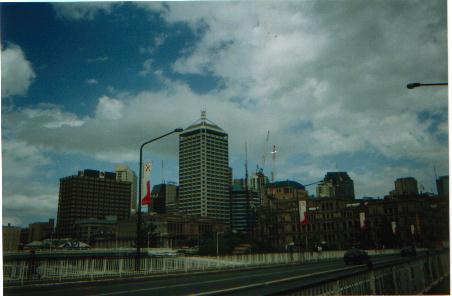
When I went to Australia – a short (4 day) trip to Brisbane, via the flight to Singapore that Magna Carta sung so evocatively of in their Airport Song – I had few clear expectations. The experience was an odd one. The initial thought, emerging in searing sunshine 2 days after setting off on a dreary September evening in England, was that I really was on the other side of the world, rather like Alice falling down a very deep rabbit hole. A question that used to be asked at school even came into my head for a fleeting moment.: ‘Why don’t people in Australia walk upside down?’. This feeling, however, didn’t last longer than the ride into Brisbane. Perhaps because it had developed as a series of ‘villages’, I found it difficult to get a sense of the place. There were some pleasant semi-tropical botanic gardens, a lot of glass towers and shopping malls where you might get charged ’10 bucks’ American-style for something, a Chinese quarter, a sense of motorways and endless suburbs. An hour’s drive or so north were views over countryside that could have been England. A short train ride to the south was the Gold Coast, a mixture of Blackpool and Tenerife’s Las Playas de Americas: hot sun, brilliantly blue sea lined by skyscraper hotels, garish neon lights, casinos, the sense of dollar signs floating in the air. Viva Las Vegas might have been a suitable soundtrack.

The choice of song here, then, might seem odd: Streets of Your Town, a hauntingly beautiful song by The Go Betweens, from their 1988 album 16 Lovers Lane. The Go Betweens were a Brisbane group that were as far away from the stereotype of a band from Queensland as possible. They took their name from L.P Hartley’s novel; they did melodic, lyrical songs by founder members Robert Forster and Grant McLennan that had a Byrds jingle-jangly sound at times; they had a female drummer. Many of their songs referenced Queensland and Brisbane and Streets of Your Town is an evocative mood song reflecting Brisbane in the era of the notorious Bjelke-Petersen Queensland government: a sunny upbeat tune with dark lyrics.

It is also a particularly interesting song for two reasons. The first is that it is one of those songs that is misinterpreted by some to be the opposite of what was intended by the authors. Streets of Your Town has been described as ‘a favourite summer song’ and has been used as a jingle by Prime Television and by Brisbane paper, the Courier-Mail, in its ads: I don’t know if the lines about butcher’s knives and battered wives were included. The best known example of songs like this is perhaps Bruce Springsteen’s Born in the USA being taken up by Reagan’s 1984 election campaign as a patriotic anthem but there have been others. Leonard Cohen’s dark, bitter Hallelujah was taken by many as a Christmas offering a la Mistletoe and Wine when Alexandra Burke’s version was released as a Christmas single after winning the 2008 X Factor. Or there was the 1973 Strawbs’ hit, Part of the Union, taken up by the Trades Union Congress at the time and others since as a union solidarity sing-along, though it had been written as a satirical anti-union whinge by group members Richard Hudson and John Ford aggrieved at having to join a union when doing a holiday job as students.(They re-surfaced later in the 1970’s as part of one-hit wonders The Monks with Nice Legs, Shame About Her Face, which I don’t think was misinterpreted by anyone as an anthem of feminist solidarity). And David Cameron was either being deeply ironical or missing the point of the lyrics when he claimed The Jam’s Eton Rifles as one of his favourite songs. (As Paul Weller put it, "Which part of it doesn't he get? It wasn't intended as a f***ing jolly drinking song for the cadet corps.")

The second is that the imagery and mood offered through the song and two accompanying videos for Streets of Your Town is totally at odds with my brief experience of Brisbane. So much, in fact, that the place in the song still exists in a parallel universe somewhere and I think that, maybe one day, I will emerge into the sunshine as from a rabbit hole and find it.


05/03/2011

European Lover


Britain and Europe have always had an uneasy relationship. There was a time when the British young man of means would undertake the Grand Tour of Europe as a rite of passage: from London to Dover and thence to Paris, Barcelona, Amsterdam, Rome, Venice, Athens, Sicily, Vienna. It was meant to round out the education and develop the character, though was just as likely to mean gambling, drinking and dalliances. It has modern echoes, I suppose , not just in the word ‘tourist’ but in the stag weekends in Prague or Tallinn or the post - school exam trips, without parents, to Tenerife or Kos. A view of Europe as a strange mixture of ‘culture’ and hedonism

At the time pop music was starting to emerge, Europe was viewed by many British with a similar confusion: impossibly sophisticated - especially places like Paris and Rome- but also somewhere to regard with great suspicion. On one hand, songs like April in Paris or Arriverderci Roma cast the romantic appeal of an old colourful travel poster in a railway waiting room, especially to people whose experience of foreign travel, if any, might be a day trip to Calais or Ostend. Petula Clark had her first UK Number One in 1961 with her version of Sailor, a roll-call of seemingly faraway places in Europe as well as the other side of the world - Capri, Amsterdam, Honolulu, Siam. A couple of years later The Bachelors scored their own similar hit with an old Bing Crosby tune, Faraway Places(With Strange Sounding Names) - which included Spain and, yes again, Siam.

At the same time, things European seemed, to many British at that time, something to be rather wary of and often quite remote. Olive oil was found in small bottles in chemists, to put in your ears. Funny foreign dishes like coq au vin or beef bourguignon were towards the exotic end of the culinary spectrum and pronounced with a very exaggerated French accent to herald their arrival. The cook and food writer, Nigel Slater, described in his book Toast - set in the mid-1960’s – the dismay caused in his household when his father daringly tried out spaghetti bolognaise for the first time:

Aunt Fanny is looking down at her lap. ‘Do I have to have some?’ I think she is going to cry...We all sit there staring at our tumbling piles of pasta on our glass pyrex plates. ‘Oh Kathleen, I don’t think I can’ sobs Aunt Fanny, who then picks up a long sticky strand with her fingers and pops it into her mouth from which it hangs all the way down to her lap. ‘No, wait for the sauce, Fanny’ Mother sighs, and then quite out of character, ’Come on, Daddy, hurry up’. Dad spoons the sauce, a slurry of reddy-brown mince that smells foreign, over the knots and twirls of pasta. Suddenly it all seems so grown-up, so sophisticated

I can remember -many years after the time Toast was set-going into a bakery shop in Lancaster and hearing someone, (probably a tourist), asking to buy some croissants. ‘We don’t sell them’ was the reply from the girl serving. ‘ I can see them there’, said the customer, pointing at the window. ‘Oh, you mean curly-wurlies’ came the surprised answer.

Times changed, of course, and horizons widened, in music as in food and culture.. As seen in the column on Paris Bells, by the mid-sixties artists like Francoise Hardy were getting in the UK charts and The Beatles could come out with some lines of French in Michelle. A few more years on and ‘European’ could even seem old hat and more bland than sophisticated - Eurovision, Euro-pop, Europe banging out The Final Countdown. Exotic travel no longer meant Barcelona or Rome but Thailand (same place as Siam but doesn’t rhyme as well),or Goa or the Maldives.

A trip round the sites and sights of Europe, however, was still a popular travel option, though the whirlwind coach tour –as in the 1969 film If It’s Tuesday, This Must Be Belgium –seemed more an American than British experience. A musical voyage round Europe’s cities also surfaced from time to time. In Dusseldorf, Regina Spektor threw in Frankfurt, Paris, Berlin, Prague, Amsterdam, Montpellier, Barcelona, Brussels, Marseilles, Corsica, London as well as Dusseldorf. In Eurotrash Girl, Cracker had a similar list, with Athens, Zurich and Turin as new additions. And in the song here from 2007, European Lover, Sheffield indie band Little Man Tate manage Paris, Amsterdam, Barcelona, Sicily and Crete – and, being from a northern perspective , London too. The itinerary described is not dissimilar to the Grand Tour of old, though Crete is perhaps in there more for the night clubs of Malia now rather than the Knossos Palace.

In this case, however, the song’s narrator doesn’t visit these places himself but instead throws their names with a mixture of wistfulness and bitterness at his former lover, away travelling and apparently getting married to someone else on the way. There is also something touchingly old-fashioned about it, as though the narrator was speaking from the 1950’s. In fact, the phrase ‘Gay Paree’ may be used ironically but it sounds like a London bank clerk in the 1890’s. ‘Going to Gay Paree, eh? It’s that Toulouse Lautrec and can-can girls over there’. (In the 1976 release Georgina Bailey by Noosha Fox , about a teenage girl’s crush on her uncle Jean Paul, ‘Gay Paree’ is used in a knowingly modern sense –and it is nice to see, in the video below, that they didn’t stereotype the French back then).

In some ways, with the breaking up of the Soviet Union, Yugoslavia and Czechoslovakia into their different parts Europe can seem more different than perhaps 40 years ago. When a travel guide on a country called Molvania came out in 2004, it wasn’t immediately obvious that it was a spoof: Slovenia, Slovakia, Moldova - why not Molvania? What probably stays true is that if one has been to any of the places in the song the memories of them - for Crete or Barcelona - will be that for that place. If one hasn’t – like Sicily – the name itself remains the adventure still.

26/02/2011

Hampstead Way


12 miles or so from Kew Gardens is Hampstead, not far at all geographically from two of the locations of previous columns – Finchley Central and Willesden/Cricklewood – but very far away in other ways. Houses there have sold for £50m but it has also long been associated with the literary, the cosmopolitan and the bohemian and presents itself as an urban village where film stars and musicians can find a home from home. Donovan, in one of his songs about London, Hampstead Incident, painted a rather mystical picture of the district: “Standing by the Everyman, digging the rigging on my sail, rain fell to sounds of harpsichords, to the spell of fairy tale. The heath was hung in magic mists, enchanted dripping glades”. (The Heath referred to is Hampstead Heath. The Everyman is an art house cinema ,once a theatre, and supposedly one of the oldest in the world. One Saturday years ago, a mist of intellectualism descended round me as I crossed the border into Hampstead from the Willesden direction and I found myself in the Everyman watching the Fellini film La Strada. In Italian.). There was also a curious British film from 1968, Les Bicyclettes de Belsize, which despite its title was a dream-like summery piece of whimsy shot round Hampstead village, with Englebert Humperdink scoring a hit with the title song. The clip below shows the opening credits panning over a scene across Hampstead.

At the same time as Mary Hopkin was singing of Kew Gardens, across London Linda Lewis wrote and sang Hampstead Way, released on her 1971 album Say No More. A British artist who has never really achieved the commercial success that her vocal and song writing talents suggest, Linda Lewis has some obvious parallels with Minnie Riperton. Before her solo work she was part of a psychedelic soul band, Ferris Wheel, that was not dissimilar to Rotary Connection. She has a 5-octave vocal range and ability to sing in the whistle register, a range hinted at in her first hit in 1973, the self-penned Rock-a -Doodle-Doo . And over her career she has blended a range of genres—pop, rock, soul, folk, funk – that make categorisation difficult.

At the time of this record, however, a better comparison was perhaps more with the singer-songwriters of the time like Joni Mitchell or Cat Stevens. This is one of her early songs and not one of her best but, unlike Kew Gardens, Hampstead Way is very much of its time. The song is apparently about a house she lived in at Hampstead Way – a road running north of Hampstead Heath – that was a kind of artistic/hippy commune: probably better situated at that time in Hampstead than her own home stomping ground of West Ham in East London. Rightly or wrongly, my mind’s eye imagines a house with a large kitchen (possibly the Funky Kitchen that is another track on the same album) where there is brown rice, aduki beans and hash cakes and a garden with a patch of herbs irregularly tended. On the record player would be an album by Captain Beefheart or the Staple Singers or maybe Fotheringay. Down the road on Parliament Hill, Pete Brown and his Battered Ornaments and the Edgar Broughton Band would be doing a free concert.

The music, too, is of an era, with just bass and guitars providing a pastoral and bucolic mood, with intermittent bursts of guitar virtuosity ( judging from the album credits these are by Chris Spedding, formerly of the Battered Ornaments and later popping up as a Womble on Remember You’re a Womble).It also ends rather pleasingly with something not that common in pop music: a burst of whistling that naturally fits the mood of sunny vibes. As shown here, whistling can work. Another effective instance was on Goldfrapp’s Felt Mountain album, on the title track and on Lovely Head, though there was a slightly sinister undertone to both of these. However, often whistling on records is either for comic effect (Always Look On the Bright Side of Life); as a musical shorthand to indicate a jolly mood,(Don’t Worry, Be Happy) ,rather in the way that milkmen in old British films are always whistling ; or sounds like the singer has temporarily forgotten the words (Jealous Guy). The story also goes with Dock of the Bay that when Otis Redding went to record it, the last verse hadn’t been written: hence the whistling outro.

To my knowledge, there have only been two hit records that had whistling all the way through: The Happy Whistler (surely a  tautology) by Don Robertson in 1956 and the 1967 record I was Kaiser Bill’s Batman. This tune had been recorded by the Mike Sammes Singers under the name of Whistling Jack Smith but when it became an unexpected hit - possibly because people found it easy to whistle to – someone had to be found to promote it on the road. For some reason, that task was given to Billy Moeller, brother of Tommy Moeller of Unit 4 +2 (Concrete and Clay) and roadie for the group. So one week he was lugging amps and drums, the next he was touring the world dressed up in Carnaby Street gear and miming to someone else’s whistling, as in the clip below.


I have not been to Hampstead that often and, because those times have been in the summer I always think of it as sunny, which suits Linda Lewis’s voice and music. There is an odd thing, however, when comparing this song to Kew Gardens from the same year. Kew Gardens could have been describing a little potential romance 100 years or more ago but it also seems very appropriate to wandering round Kew Gardens today. However, I would not imagine that any of the world in which Hampstead Way was set would be visible  today if you walked down the road. The street and buildings are there and the views would be much the same as 40 years ago, I guess, but the rest might as well be from 500 years ago. Maybe this says something about how the past can be recast or erased to suit the present. Or maybe ‘Everything’s OK now, Hampstead Way’ was always a state of mind more than anything : somewhere where it is always sunny and someone is whistling in the garden. If so, then perhaps after all Hampstead Way does escape its moorings in the London of 1971 as much as Kew Gardens has.

19/02/2011

Kew Gardens


An aspect of many places, commented on in previous columns, is that they can hold the past and present simultaneously. London, in particular, has always been a good example of this, where you can quickly move from the present to find a hidden square or side street that seems little changed since the London of Dickens or beyond, or a park that seems a hidden world away . The best songs can enhance this perspective –as with Cath Carroll’s London, Queen of My Heart, taking the night bus from Camden over the ancient plague pits.

In some ways this searching of the past by pop songs can seem odd. Pop music’s initial concerns were very much of the here and now but at some point - maybe it was with Sgt Pepper - artists started taking off into past centuries. Strange instruments like harpsichords and dulcimers started to appear on pop records. One musical path headed back to the 19th Century English surreal whimsy of writers such as Lewis Carroll and Edward Lear: the spark was the Syd Barrett - dominated Pink Floyd first album, Piper at the Gates of Dawn, the title taken from a chapter of Kenneth Graham’s Wind in the Willows. Another path at the turn of the sixties went further back to a courtly Elizabethan age, perhaps kicked off by the Stones and Lady Jane. Sandy Denny brought her song about Mary Queen of Scots, Fotheringay. to the Fairport Convention album, What We Did On Our Holidays. Soon after she named her own group after the song, their first album depicting the group members dressed up in cod mediaeval clothing. Around the same time the folk rock outfit, Trees, brought out The Garden of Jane Delawney, also drenched in echoes of the 16th century.

The song here, Kew Gardens, is not time - bound and could be set at any time in Kew Gardens’ history, with the same kind of courteous and graceful feel of the songs mentioned above. Prominent in the musical backing is the recorder, previously associated with the mediaeval court or small children playing in school concerts. It was written and first recorded by Ralph McTell, of Streets of London fame, before being picked up by Mary Hopkin and is very characteristic of some of his work: veering to the whimsical but carried by his ability to tell a descriptive little story in 2 or 3 minutes (In the 1980’s he featured in an oddly compelling children’s TV series, Tickle on the Tum, in which he appeared in a grocery shop in a fictional village every week to showcase songs like this one). In this case, the musical vignette is a brief and rather sad love story-that-never-was against a backdrop of the Pagoda and the griffin statues outside the Palm House.

This version is by Mary Hopkin, released as a ‘B’ side in 1971. She holds a comet-like place in pop history. Her debut single in 1968, Those Were The Days, was the first release after Hey Jude on the prestigious Beatles’ Apple label, was produced by Paul McCartney, went to Number One and sold over 8 million copies worldwide. By 1970, after 3 or so smaller hits, her chart career was over. In some ways, she seemed out of time, like this song and Kew Gardens itself. She was too late for the pop folk boom of the mid-60’s, too early for the singer-songwriter genre of the 1970’s and caught between the rapidly diverging worlds of rock and pop. Her crystal-clear voice was not dissimilar to the early Marianne Faithfull and she recorded some of the same sort of folk tunes that Marianne Faithfull had in the mid-sixties. Image-wise, however, she was the opposite, marketed on TV variety shows and in cabaret as a ’girl next door’ with family appeal.

She also suffered, I think, from associations with two shows: Opportunity Knocks and The Eurovision Song Contest. Opportunity Knocks was a long-running talent show on British TV in the 1960’s and 1970’s, with winners chosen by public vote. These included a singing dog and, for 6 consecutive weeks in 1964 when the Beatles and Rolling Stones were topping the charts, by a bloke twitching his muscles to the cha-cha-cha sounds of Wheels by The Stringalongs. This can be glimpsed on the clip below. (This is from 1978, by which time he had been doing the act for 14 years. Viewers were less demanding then).


Mary Hopkin won the show in 1968 but, as another winner/subsequent chart act, Sweet Sensation, found later, that did not help in giving wider musical credibility. Neither did being the British entry for the 1970 Eurovision contest with Knock Knock, Who’s There – it took Abba winning in 1974 to turn that view of Eurovision around.

Her gentle and rather wistful style, however, is perfect for a song about  Kew Gardens, where it is easy to feel you have gone back to a more sedate age of the Victorians or Edwardians as you stroll along tree-lined walks or through the elegant buildings. I first went there as a young child and three things stuck in my mind. 1) The entrance fee through the turnstile gates was 1p, which even then struck me as good value. 2) The Chinese Pagoda there seemed wildly exotic, as though suddenly transplanted from China itself ( I am sure that a group in the 1970’s put out an album with them standing by the Pagoda on the cover and claimed that they had recorded it in China). 3) In one of the cafes I was served, I believe for the first time, the dish called ‘salad’. This was both unexpected and disappointing, being the great British Salad of the time – some lettuce and tomatoes, a piece of ham, a chopped hardboiled egg and Heinz Salad Cream. Years later, however, on a family visit there, we spied a much more fitting meal for Kew Gardens: seated by the river was a group dressed entirely in white - white suits, white flowing dresses – with a hamper picnic of smoked salmon, strawberries and cream and champagne laid out on the grass. Somehow it did not seem out of place.

The song, in some ways, is a period piece but then so are parts of Kew Gardens, with the Walled Gardens and Queen Charlotte’s Cottage and the maids of honour cakes in the tea room on the road opposite the entrance. Go through the gates - you can then find what ever age you want as you wander round the gardens.

12/02/2011

Made In Malaysia/Here In My Home


A theme of these columns has been that some places, for many reasons, carry before them more mental associations than others. For me, Malaysia was one of those that remained hazy. Many of its neighbours - Vietnam, Thailand, Java, Bali - called a set of images,rightly or wrongly, to mind. However, Malaysia was never really a country that figured much in my consciousness and before going there I had no real idea what to expect. What notions of the place I had came from a random mix of sources over the years. I had no real picture of the capital, Kuala Lumpur, other than knowing that for a while it had the tallest building in the world, the Petronas Towers. The Straits of Malacca, with a history of piracy, sounded wildly exotic. The Tea Plantations of the Cameron Highlands sounded like a genteel echo of a colonial past.

There had also been the occasional old films on TV set in Malaya: The Long, The Short and the Tall, based on a play about British soldiers in Malaya in WW2, and A Town Like Alice. There were sometimes reminiscences in the paper or on the radio of British National Service time spent in Malaya, with memories of the jungle and Kuala Lumpur and Tiger Beer. National Service in the UK ended in 1960 so there was a short overlap with the rise of British rock and roll and pop and the odd musician – like Danny Thompson of Pentangle - found themselves doing their bit overseas in Penang. However, not only did national service seem incompatible with the ethos of rock and roll but the time out of civilian life could also end a pop career before it had really got going. Singer Terry Dene was probably the biggest pop casualty of this at the time but  Adam Faith apparently considered having one of his toes cut off to avoid call-up and his career crashing. It was therefore ironic when the cry from Middle England went up at the sight of the early Rolling Stones - “What they need is a bath and a hair cut and a spell of national service would do them all good” . This overlooked the fact that one of the band, Bill Wyman, had already done his National Service – 1955-1958, RAF Oldenburg, Germany –and look what it did for him.

There seemed few non-Malaysian songs about the country. The Small Faces gave the capital a mention in their 1968 song, Rene, “romping with a stoker from the coast of Kuala Lumpur”. More recently American outfit Bombadil also sang of Kuala Lumpur: ”monsoon winds will take you home to my Malaysia, Kuala Lumpur, Kuala Lumpur all day, so much to say”. There seemed little else. When I went to Malaysia, therefore, I went with no set expectations. Parts of Kuala Lumpur , with the Petronas Towers, the huge artificially lit shopping malls of consumer goods and elevated rail system, seemed ultra-modern, rather like those futuristic drawings people in 1960 produced when imagining the cities of 2000. However, a train and boat ride away there was Crab Island - Pulau Ketam, an island fishing village built on stilts – and which sounds like the title of a really exciting Famous Five adventure story (The only flaw in going is that if you are not that keen on crab, you are a bit stuck as to what to choose in the restaurant there).

A couple of hours to the south, Malacca lived up to its exotic image, with the bonus of a canal system from a Dutch past and the Dutch Harbour Cafe, serving hagelslag and apple cake. There were also unexpected musical delights. At the Geographer Cafe on Jonker Street in the Chinese quarter, Mr Burns, the coolest cat in town, entertains most evenings with an eclectic range of songs from early rock and roll through the Bee Gees to J J Cale and all points in between. One evening his version of Cliff Richard’s The Young Ones floated incongruously over the nearby street stalls selling frog porridge , mingling with the sounds of outdoor Chinese karaoke.

What was also apparent was the wide mix of cultures - Malay, Chinese, Indian, Indonesian - and the active promotion of a sense of national unity and ‘one Malaysia’. This is reflected in different ways by the two songs here. The first is Made in Malaysia, a patriotic anthem by Roots n Boots, a Malaysian skinhead punk band influenced by the Oi! sound. Though it sounds like something Sham 69 might have done in 1978, it came from their 2000 album Working Class Heroes, part of a largely underground music scene. The other is the 2008 Here in My Home by Malaysian Artists for Unity: a more ‘official’ musical statement and a kind of Malaysian We Are the World.

The visit also gave rise to a common holiday experience. A glass of retsina can taste wonderfully authentic in an outdoor Athens cafe in the shadow of the Acropolis but can start you worrying if you have mixed it up with the Jeyes pine disinfectant when tasted in the front room at home. A CD of Croatian folk music can suddenly sound less interesting when heard again out of context. And a sketch of Malacca purchased from its Chinese artist in his shop can seem not really naïf art when opened up after the journey back to England. What remained, however, was a sense of a kaleidoscope of a place: shifting images of colour and sound. It is then not hard to see where the Tourist Board marketing slogan of 'Malaysia, Truly Asia' came from.


05/02/2011

Finland


A desire to see a place can come from the smallest incident. A wish to visit Greece came from seeing a photo of Mount Olympus in an encyclopaedia once. Then as a child I came across a Moomin book, either as a present or from the library: Moominland in Midwinter, I think, where the hibernating Moomin wakes halfway through the long dark winter and unexpectedly sees a strange and sometimes frightening world previously unknown to him. More than the characters, it was the settings of the book that really got my attention, with the descriptions and pictures of the forests, hills and valleys, lakes and islands and the sudden surge of colour as winter ends and everything springs back to life. There was something magical - in the sense of a fairy tale - about it and also something rather surreal, (though I wouldn’t have recognised the term then).

But at the same time I was also vaguely aware that it was based on a real country. The back of the book I read had a note about the author, Tove Jansson, who did much of her work on a small island in the Gulf of Finland where she, and sometimes her mother and brother, were the only inhabitants. This seemed a wonderful adventure . She later wrote of it:

It is so small you can walk around it in ten minutes. It is shaped like an atoll and surrounds a deep lake which in good weather makes a fine swimming pool, but in bad weather turns into a raging torrent surrounded by waterfalls. Then our boat has to be pulled right up to the house and tied to the veranda. We only have one tree, a rowan, which bloomed for the first time last summer. But we plant wild roses in the crevices, and potatoes. And we fish. We use rainwater for our coffee and driftwood for our fires. My favourite weather is fog, when the island seems to be afloat at the very end of the world in perfect silence and solitude. Only rarely does one hear the foghorns from the open sea where big ships go by for foreign countries.’

It was this notion of Finland – a mysterious, rather melancholy, place of endless forests and lakes and full of silence – that I carried with me. Statistics said there were 187,000 lakes, 180,000 islands, forest over 70% of the land. This was brought home on my first visit there. Having been dropped in the small town of Karjaa one evening from a union conference centre a few miles away in the countryside, I realised when it was time to get a taxi back that I wasn’t sure where it was - other than it was in a forest by a lake.

Solitude seemed easy to find. A teacher from Kuopio told me of some supply work she had done in a tiny country school, where she brought in finger puppets to bulk out her class of two children. At least it made calling the register last a bit longer. At lunch time they went into the fields outside and picked blueberries. The Finns also have a reputation (when sober) for silence or not talking much. I remember reading about an exchange student whose family hosts didn’t speak to him for the first 3 days. They weren’t being rude, it was just how they were.

Music from Finland , other than Sibelius and Finlandia, is not much known in the UK. It was a novelty to discover, for example, a popular Finnish dance called the Humppa (derived from German oompah music) and which looks like the name sounds. There is also a Finnish tango though, unlike the better known one from Argentina, its mood is apparently sad and nostalgic . Neither have there really been any Finnish equivalents of Abba, Bjork, A-Ha or even Aqua. The first, and apart from Hanoi Rocks possibly only, Finnish group to spring to mind is Lordi, the heavy metal group dressed as monsters that unexpectedly won the 2006 Eurovision contest with Hard Rock Hallelujah: a long way from All Kinds of Everything and Puppet on a String.

Neither have there been many songs about the country. As mentioned in a previous column, the Monty Python song Finland summed up the general lack of knowledge about the place-“You're so sadly neglected and often ignored, a poor second to Belgium when going abroad”.  Helsinki has fared a bit better. 70’s prog-rock band Wigwam painted a little picture of the city in Helsinki Nights: “An' you can go up by the railroad yard, coast on down by the Boulevarde, out along past the shipping docks, Fisher women all counting their stocks” .Swedish-Finnish group Laakso gave a rather different image of Helsinki in their rather kitsch song and video, Italy Vs Helsinki.

However, the song here, Finland, by The Redwoods (primarily American artist and musician Wesley Berg), is from a whole 2010 album about Finland, Jarvi,  ‘written and recorded in a small cottage in Alajarvi’. The lyrics of this and some of the others are cryptic but the sound of the songs captures, for me, the feeling of Finland. There is a sense of the dark forests and lakes –“quiet lakes with pinewood dust” - , a feeling of space and also of melancholy, noises at the edge of the music like something in the trees just at the periphery of your vision.“Fall Winter breeze has whispered things and carved out words on evergreens” (Bonfire). In this setting it is easy to see where the dream-like quality of Tove Jansson’s books came from.

Link to song

29/01/2011

Welcome to the Isle of Wight


Since the time of the ancient Greeks and the travels of Odysseus, the whole notion of ‘islands’ has drawn people in a romantic fascination. The history of literature is full of novels that reflect this allure: Treasure Island, Coral Island, Robinson Crusoe, Swiss Family Robinson. In real life, the rich, the artistic and the drop-out have sought inspiration or escape on an island. Lawrence Durrell on Corfu, D H Lawrence on Sardinia. Tove Jansson, author of the 'Moomin' books, lived much of her life on a small island, Klovharu, in the Gulf of Finland. John Lennon handed over an Irish island, Dorrinish, to Sid Rawles and his Digger band to start a commune there. Agnetha Faltskog disappeared off for years to the Swedish island of Ekero when Abba broke up.

Songs about islands have generally followed this romanticism. Harry Belafonte sang of an Island in the Sun:”all my days I will sing in praise of your forest waters and shining sand”. Weezer did a song with the same title: “On an island in the sun. We’ll be playing and having fun” . The Beach Boys scored a late career hit with Kokomo, which rattled off a whole load of exotic islands. Blondie went for Island of Lost Souls. The Springfields settled for an Island of Dreams.

The British have tended to look to the Mediterranean or Caribbean islands for their holiday fantasies but it does have plenty of its own, including Jura, where Orwell wrote 1984. The largest off England, however, is the Isle of Wight and its popular image is probably as far away from the exotic fantasies of the above as you can get –definitely more towards the comfy end of the spectrum. There was a short-lived time when the IOW Festivals were the epitome of cool happening. In 1969, Bob Dylan chose to play there over Woodstock. In 1970 a line-up including Jimi Hendrix, the Doors, the Who and Miles Davis attracted an estimated 600,000, more than Woodstock. (Though Joni Mitchell did actually attend this one, it didn’t inspire any songs starting ’By the time I got to Afton Down’...). In 1971 the Isle of Wight Act was passed, preventing unauthorised gatherings of more than 5000 and that was that - the festival baton passed to Glastonbury.

Though annual festivals started again a few years ago, the Isle of Wight is largely known in the popular imagination for two things. The first is as one of the ‘this sounds unbelievable but maybe it is true’ statements that regularly turn up – in this case ,’if all the world’s population stood shoulder to shoulder they could fit on the Isle of Wight’. Statisticians disagree on this one, with the balance towards ‘probably not. ’The second is as the place to go for a trip that goes back to the England of the 1950’s, for a traditional bucket and spade week or two on the beach or the sort of holiday that Enid Blyton’s Famous Five might have had: bicycles, hikes along the cliffs past lighthouses, isolated coves, ice-cream and lashings of ginger beer. There can be simple pleasures – getting glass phials of coloured sand at Alum Bay; seeing an animated Allosaurus singing the Eton Boating Song in the Blackgang Chine amusement park; getting on a bus at Sandown, waiting till a woman gets on and exclaiming, “She’s got a ticket to Ryde”. And there are also little surprises. One might come across island resident Jet Harris, the original bad boy bass player and founder member of the Shadows, who lost their charismatic edge when he left.

Listeners often expect songs to reflect the image of the place they are about, so mandolins and strings for Venice, accordions for Paris, waltz-time for Vienna. New York fits a song like the Lovin Spoonful’s Summer in the City, with its snare drum/pneumatic drill intro and traffic sounds. With this in mind, what sort of song would fit the Isle of Wight? Brass band music or a folk song, or something that would suit the feeling of going back in time a few decades: a Craig Douglas song perhaps? Reggae, even if reggae-lite, probably wouldn’t come to mind. Reggae has, of course, been part of the British music scene since the early 60’s, with Millie Small’s bluebeat My Boy Lollipop probably being the first UK hit in 1964. Over the years it has had its highs and lows. There was Susan Cadogan, a librarian from Kingston (Jamaica) University, taking Millie Jackson’s Hurts So Good into the UK charts in 1975. There was also Paul Nicholas taking Reggae Like It Used To Be into the UK Charts in 1976. See his song and marvel at some dancing that is surely not like anything used to be. ( Trivia note. The 2 women dancers in the clip had appeared as scary blonde twins in the 1960 film Village of the Damned) .


Reggae has done plenty of songs about places - like Steel Pulse’s Handsworth Revolution or Sandra Cross’s Country Living - but rarely about family seaside resorts. However, the 2009 offering by Derek Sandy, Welcome to the Isle of Wight, is just that, with a song that seems destined for use by the Tourist Board with its praise for the place. In some ways it is from the same genre as Taking a Trip Up to Abergavenny in that the place described in song exists more in the imagination or parallel universe than reality. Just as a visitor to Abergavenny might be disappointed by the lack of sunshine forever and paradise people so a visitor to the Isle of Wight should not really expect a tropical paradise after a journey over the sea, on the ferry across the Solent from Southampton or Portsmouth. They may well find it fits the laidback mood of the tune: whether it is the best place they have  ever seen is, of course, up to them.

22/01/2011

Week - end a Rome


Some places have stock sayings or proverbs associated with then that immediately spring to mind. ‘If you are tired of London, you are tired of life’, or ‘See Naples and die’. Rome has perhaps more than most. It wasn’t built in a day; all roads lead to it; when in Rome... In fact, all of these have turned up in song titles- by Morcheeba, the Stranglers and Phil Ochs respectively.

It is also one of those places that writers have waxed lyrical about over the centuries. ‘A poem pressed into service as a city’; or ‘The city of echoes, the city of illusions, and the city of yearning.’ Like Athens, tourists flock to see its antiquities, the Coliseum, the Catacombs and Pantheon. But, like Paris, it has also had an added dimension of chic cool, with its bars and boutiques, coffee bars, the scooters and leather jackets. Think of some of the iconic cinematic images of Rome: the Trevi Fountain scene with Anita Ekburg in La Dolce Vita or Audrey Hepburn and Gregory Peck whizzing round the streets on a Vespa in Roman Holiday.

Songs about Rome have tended to the romantic. Three Coins in the Fountain set the tone back in 1954, with the song and film actually adding to one of the city’s legends . Since then the story has been that throwing 3 coins in the Trevi fountain is lucky, overlooking the fact that 3 coins were thrown in the film/song because there were 3 characters. By such trivialities are some myths made. (A similar one might be the famous Zorba’s dance by Alan Bates and Anthony Quinn in Zorba the Greek, copied by sozzled diners in countless Greek restaurants ever since. According to Quinn it wasn’t a traditional Cretan dance: he made up the shuffling dance steps at the time because he had injured his foot.). A string of other songs took forward the notion of a city of romance. Petula Clark sang of Romance in Rome; Perry Como of Arrivaderci Rome; Elvis Presley promised that he would ’make a wish in every fountain’ in Heart of Rome (unlikely given his lack of travel outside the USA). It took Bob Dylan and When I Paint My Masterpiece to put Rome in a different light.

The song here, Week-end a Rome, goes more for the chic bohemian image. The song has a complicated history. It first appeared in 1984 on the electro pop album La Notte, La Notte by French singer Etienne Daho. In 1995, it turned up - remixed and with totally new English lyrics - as the St Etienne hit, He’s on the Phone. In 2010 Vanessa Paradis went back to the original and slowed it down with a gentle bossa-nova rhythm , with Daho popping up to provide the spoken Italian segments. Daho is only known in the UK, if at all, for his work with St Etienne in the 90’s. Vanessa Paradis, however, first appeared in the UK charts in 1988 at the age of 15 with Joe Le Taxi, becoming one of a small number of artists to have scored a hit there with a foreign language song – joining the Birkin/Gainsbourg collaboration, of course ,as well as the Singing Nun ( Dominique), Kyu Sakomoto ( Sukiyaki,) Plastique Bertrand ( Ca Plane pour Moi), Yolanda Be Cool (We Speak No Americano), and Los Lobos ( La Bamba) amongst others.

With lyrics in French and Italian, some of it slang, it is the general feel of the song that hits an English listener first, making Rome sound the epitome of stylish cool. The general gist of the lyrics seem clear. It is raining in Paris and the song’s narrator suggests that a weekend for two in Rome-perhaps Florence and Milan too - would give a taste of the good life : imagine driving with the wind in your hair and the radio playing. ‘Because we are young, Italian weekend’. In the video accompanying the Daho version, he is seen sitting in a cafe under a poster for the Antonioni film, La Notte (La Nuit), suggesting the ‘La notte, la notte’ refrain has a cultural reference as well.

So far so good, There are, however, some tricky bits. Take these lines:

"Afin de coincer la bulle dans ta bulle, D'poser mon coeur bancal dans ton bocal, ton aquarium."

A literal translation suggests the intriguing statement:

"To jam the bubble in your bubble ,to put my wobbly heart in your jar, your aquarium"

It may well be that it reads differently in French. Or they could be lines left over from a Serge Gainsbourg song.

My own experience of Rome was a day rather than a weekend, during a family holiday in Terracina an hour or two to the south. The Italian couple who managed the apartment in Terracina spoke no English so conversation was comfortingly predictable, with variations on a fixed set of questions. Stanco? (tired). Fame? (hungry). Caldo? (hot). Freddo? (cold). Early one morning the husband dropped us at the local station to get the train to Rome, where we spent a hectic tourist day seeing the Coliseum, Trevi Fountain, and Vatican and having gelato and coffee. When we returned late in the evening he was waiting for us at Terracina station and asked us about the day in Rome. Stanco? Fame? Freddo? What he meant was ‘Rome, Pour la douceur de vivre, et pour le fun’

Link to Etienne Daho song

Link to Vanessa Paradis song